Count how many people used the desk your staff member sat at this morning. In a hot-desking office, the honest answer is that nobody knows the tally. Someone used it Tuesday, someone else Thursday, and the keyboard hasn’t left the desk either time. Most commercial office cleaning services focus on floors, bins, and washrooms because that is what a walkthrough shows and what a building looks like at a glance. Shared equipment on every desk rarely appears in the specification being quoted for the offered services.
That omission shows up later as absence. Flexible seating spreads contact across far more people than fixed desks ever did, and commercial office cleaning services built for a traditional layout do not account for it. A floor can look immaculate while the things your staff actually should touch go untouched for weeks.
Here is where the gaps sit.
Shared Desk Equipment and High-Contact Office Surfaces
Keyboards are the obvious one. Less obvious are the items around them.
Mouse units collect skin oils in the scroll wheel and along the grip. Telephone handsets hold a mouthpiece against a face, then get passed on. Monitor arms and height adjusters get grabbed by every new user. Desk dividers and privacy screens constantly pick up fingerprints.
Ask whether your current provider cleans any of these. Many don’t, and their reasons are usually reasonable. Nobody asked them to, and touching the IT kit without instruction carries risk.
Items worth naming in a specification:
- Keyboards and mouse units
- Telephone handsets and headsets
- Monitor stands and adjustment controls.
- Docking stations and cable tails
- Chair arms and height levers
- Desk booking tablets or screens
That last one is almost universally missed. The booking panel is touched by every single person who sits there, which is rather the point of it.
See also: Best Brands of 15K Vape: Top 15,000-Puff Vapes to Consider
Meeting Rooms and Shared Technology in Flexible Offices
Meeting rooms turn over faster than desks and get cleaned less often. Think about what a room accumulates in a day.
Remote controls. Conference phone units with buttons pressed by whoever happened to be nearest. Touchscreen displays covered in finger marks. Whiteboard markers handled by half a dozen people.
Table surfaces usually get wiped. The technology on them generally doesn’t, and that’s where contact concentrates.
Breakout spaces follow the same pattern. Coffee machine buttons, fridge handles, microwave keypads and kettle switches absorb traffic all day. The canteen floor might be spotless, while the machine dispensing everyone’s coffee hasn’t been wiped since Monday.
Why Zoning and Colour Coding Matter More in Shared Offices
Cross-contamination worsens as sharing increases, and this is where the cleaning method matters more than cleaning frequency.
A cloth used in a washroom should never reach a desk. It sounds obvious written down. Yet without a colour-coded system and training, clothes move freely around a building because they all look the same.
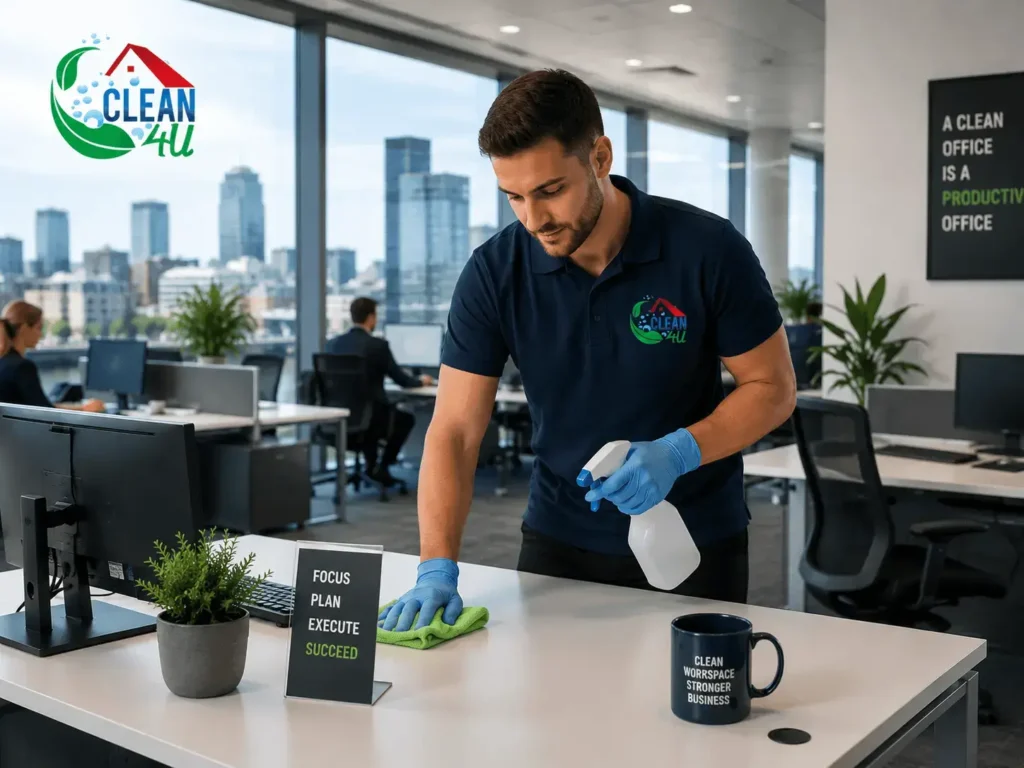
Clean4u operatives follow a colour-coded microfiber system that keeps washroom tools separate from canteen and desk areas. HEPA-filter vacuums capture fine dust instead of releasing it back into the room, which matters around IT equipment where dust settles in vents and keyboard gaps.
Vacuum filtration is quietly one of the bigger differences between providers. A cheap machine moves dust from the floor into the air, where it lands on the desks you just cleaned. Perhaps that sounds pedantic. It is also why some offices feel dusty the morning after a clean.
Frequency Should Follow Occupancy, Not Floor Area
Most schedules get built from square footage. Occupancy patterns tell you more.
A floor at 40% capacity with people moving between desks daily has different needs than a full floor with fixed seating. Rotation drives contact, not headcount alone.
Questions worth asking before setting a schedule:
- Which desks get booked most often through your system
- Which days run heaviest
- Are meeting rooms turning over hourly or sitting empty
- Does anyone currently wipe shared kit, and when
Desk-booking data answers most of this, and almost nobody uses it for cleaning. It is already in the system.
Setting Standards You Can Actually Check
Vague specifications produce vague results. “Clean the office” means whatever the person holding the cloth decides it means that night.
Write down the shared items by name. Say how often each gets attention. Agree who signs off. Clean4u runs a supervisor walkthrough at the end of each visit, which gives you a point of accountability rather than a guess.
Then check it occasionally yourself. Pick three desks at random and look at the keyboards. It takes two minutes and tells you more than any report.
One caveat worth holding. Cleaning isn’t the only variable in office hygiene, and claiming otherwise would overstate its importance. Ventilation, hand-washing facilities, and whether people come in while unwell all play a part. Cleaning is simply the part you directly control through a contract.
Clean4u provides office, contract and commercial cleaning across Dublin 1 to 24 and the Greater Dublin Area, dispatching from Ballsbridge on the Southside and Santry on the Northside. Operatives are permanently employed, not sourced through agencies, fully insured with public and employer liability cover, and equipped with eco-certified, biodegradable products. We arrange cover when an assigned operative is absent, so scheduled visits are maintained.
Request a quote for your premises at clean4u.ie/contact-us.