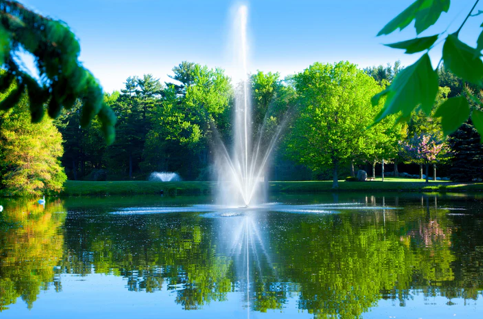
Managing a large pond, retention basin, or decorative lake is harder than most people expect. The water looks fine for a while. Then one summer it doesn’t. The smell hits first, then the algae, then the complaints from whoever uses or owns the property. By that point, the water quality problem had been building up for months. Scott fountains are one of the more practical tools for staying ahead of that curve.
Scott fountains get used in these situations more often than people might realize. They show up in municipal parks, golf courses, corporate campuses, and large residential developments for a reason. Let’s break down what they actually do and why they work at scale.
What Makes Large Water Features Different
A backyard pond and a two-acre retention basin are not the same problem. Larger water bodies hold more volume, stratify more severely, and accumulate nutrients at a rate that smaller aeration systems simply can’t address.
Thermal stratification gets more pronounced as surface area grows. The sun warms the top layer while the bottom stays cold and oxygen-poor. In a small pond, wind and natural mixing help. In a large feature, natural circulation barely reaches the center. The stagnant zones that form in deeper areas become oxygen-dead zones where organic matter breaks down without adequate oxygen, releasing phosphorus and nitrogen back into the water column.
Those nutrients feed algae. And in a large water body, an algae bloom doesn’t just look bad. It can affect downstream water quality, create liability concerns for property managers, and, in the case of cyanobacteria, produce toxins that pose real risks to people and animals who use the water.
That’s the fear a lot of facility managers carry quietly. One bad summer can turn a feature that took years to develop into a public relations problem.
How Scott Fountains Address These Issues
Scott fountains operate on the principle of surface aeration. The motor-operated impeller sucks up water and sprays it into the air in a wide pattern. The sprinkled water comes into contact with the atmosphere and is aerated through the method of reaeration. The water then falls back and infiltrates other deeper layers of water, thus interfering with the stratification that contributes to the worst water quality.
The spray patterns on larger Scott units cover a significant surface area. Some models produce spray diameters of 20 to 30 feet or more, depending on the nozzle configuration. That coverage matters in large features where a single small aerator would barely make a dent.
The U.S. Environmental Protection Agency notes that adequate dissolved oxygen levels, generally above 5 mg/L for most aquatic life, are a baseline requirement for healthy water bodies. Surface aeration through fountain-style systems is one of the more practical ways to maintain those levels in features that lack natural flow.
See also: Why So Many Peru Tours Look Great Online but Disappoint in Person
The Aesthetic Factor and Why It Actually Matters
There’s a practical side to how Scott fountains look that goes beyond appearance. A visible, well-placed fountain signals active water management to anyone who sees it. Property managers at parks and HOAs often find that residents or visitors notice water quality problems immediately but rarely notice the ongoing work that prevents them.
A fountain running consistently communicates that the water is being managed. That perception matters. It also creates gentle pressure to keep the system maintained, which is probably a good thing.
The spray height and pattern options on larger Scott units let property managers choose configurations that fit the scale of the feature. A low, wide fan pattern suits a retention pond where visual subtlety is preferred. A taller geyser pattern works for a formal park setting where the feature is meant to be seen. Perhaps this flexibility is one reason they get specified so often in commercial and municipal projects.
Energy and Operating Costs
Running a large fountain continuously adds up. Scott fountain motors in the larger size ranges typically draw between 1 and 5 horsepower, depending on the model. At continuous operation through peak summer months, that’s a real cost to account for.
Some property managers run fountains on timers, operating them during the most heat-stressed periods rather than around the clock. Research from extension programs at several land-grant universities suggests that nighttime aeration is particularly worth maintaining, since photosynthesis stops after dark and dissolved oxygen levels drop without it.
Long-Term Water Quality Trends
The changes that come from consistent fountain operation in large features take time. A single season won’t reverse years of nutrient accumulation. What tends to happen is a gradual reduction in algae frequency and severity, improved clarity, and fewer odor complaints.
It’s not a guarantee. Water quality in large features depends on the surrounding land, inflow sources, and how the basin was designed. But aeration through a system scaled to the feature is one of the more reliable tools available.